
Planning for a sustainable future
Plans to install an additional wind turbine to provide a secure and reliable source of affordable green electricity to power our manufacturing operations
Powering our industry renewably
The Project
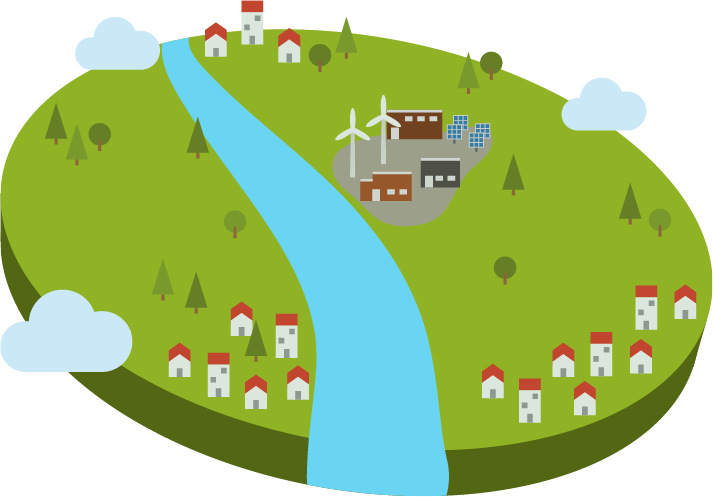
We are KL Technologies, a long-established and successful local company manufacturing products for export around the world. We have been established in King’s Lynn since 1965.
We have plans to further invest in the local economy, increase production capacity, and create more jobs in the area.
To achieve that, we need to install an additional wind turbine to provide a secure and reliable source of affordable green electricity to power our manufacturing operations.
We have been producing our own renewable electricity using solar and wind for some years, but our continued investment and expansion means that our energy needs are growing. That’s why we are now proposing a second wind turbine on site, and we are consulting with our local community on these proposals before submitting a planning application to King’s Lynn & West Norfolk.
Our existing wind turbine has been in place since 2014 and has received no complaints from local residents regarding noise or visual impact.
The consultation closed on 11th. March. We’d still like to hear from you if you have any suggestions or thoughts on our proposals, you can contact us in the following ways:
Email: info@kltechnologies.co.uk or Phone: 01553 622000
YOU CAN VIEW THE FULL COMMUNITY ENGAGEMENT REPORT HERE.Summary of Community Engagement Report
This summary document has been prepared following completion of the recent public consultation exercise carried out by KL Technologies between 21st February and 11th March. It serves to provide an interim summary update to key stakeholders on the level of responses received and the key themes that emerged.
It does not provide KL Technologies’ full response to the consultation and how consultation comments have been considered in any design iteration. Work is ongoing to consider the comments in full and a final update will be provided in a final report which will supplement a planning application due to be submitted in 2022, titled ‘Community Engagement Report’.
The proposed Single Turbine is a continuation of KL Technologies’ commitment to the generation of green energy on their manufacturing site in King’s Lynn. The proposal is for a single 1.5 MW turbine with a maximum height of around
100 m, with all cabling underground.
KL Technologies resolved to adopt a comprehensive and broad approach to consultation, providing as many avenues as possible for members of the public to engage, in an accessible way.
The proposed Single Turbine was announced on 21st February 2022, and a three-week public consultation periodfollowed, in order to provide the local community the opportunity to engage in the process.
On 21st February, the scheme was announced via a press release, and the project website went live. The website provided information on the key features of the project, and an online feedback form.
The same week, local residents living within an approx. 1.5 km buffer zone of the site (2,864 households) received an information booklet through the post. A printed, pre-paid feedback form was also included in the booklet for those who wished to return their comments by post.
The virtual exhibition received 94 unique views and 39 people completed online feedback forms. 109 people returned a paper feedback form.
In total, people engaged with KL Technologies and Cadno Communications 246 times through contact with stakeholders, unique website visits, online and postal feedback, and via email and telephone.
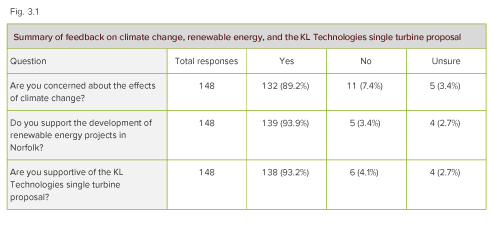
In both the postal and online feedback form, direct questions were asked about climate change, about renewable energy projects in Norfolk, and specifically about the KL Technologies proposal.
89.2% of respondents reported that they were concerned about the effects of climate change.
93.9% of respondents indicated that they were supportive of the development of renewable energy projects in Norfolk.
93.2% said they supported the KL Technologies proposal, with only 4.1% indicating that they were not supportive of the proposal and 2.7% saying that they were unsure either way.
The following themes emerged from stakeholders and residents who responded to the consultation or participated in consultation events. In this section we have listed the key themes, included examples of comments from residents, and KL Technologies’ response and proposed action.
- Positive feedback and support for the project
The overwhelming majority of comments received from both the online and freepost feedback methods were supportive of the proposal and of renewable energy initiatives in general. - Ecology and wildlife concerns
In response to concerns raised around the impact of the turbine on local ecology and wildlife, the KL Technologies
project website and information booklet explained that ecological surveys have been undertaken and gave assurances on the environmental and ecological impact of the proposal.The surveys that have been carried out showed no evidence to suggest that a wind turbine in this location would have any significant or unacceptable impacts on designated sites, birds, bats, or other protected species. KL Technologies are committed to minimising any potential environmental impacts associated with the generation of renewable energy on site, including impacts on wildlife and ecology. - Visual impact
Responding to comments regarding the visual impact of the proposal, KL Technologies will fully assess the visual impact of the new turbine from different viewpoints, taking into consideration the existing turbine. Whilst the turbine will be seen from the surrounding area, it is not anticipated that this will be regarded as an unacceptable visual impact. The area where the turbine is to be sited is already industrial in nature. Moreover, since the installation of the existing turbine 8 years ago, KL Technologies have received no complaints or concerns about visual impact. - Turbine noise and shadow flicker
Two comments were made about the existing turbine on KL Technologies’ site, specifically about shadow flicker and the noise.The existing turbine has been in place since 2014 and has received no complaints regarding noise.The shadow flicker assessment for the current proposed turbine will take any comments into consideration and suggest suitable mitigation where required.
Improved design of wind turbines has drastically reduced the noise of the mechanical components, and even in the intervening 8 years since the last turbine was installed, it is expected that the new turbine will be an improvement.
Often the most audible sound is that of the wind interacting with the rotor blades, rather than a mechanical sound. In terms of shadow flicker, careful siting of the turbine should minimise issues of flickering. - Surplus energy/Grid connection
A number of respondents mentioned the possibility of surplus energy that may be generated by the turbine and asked whether this could be sold back to the grid or used to benefit local residents or businesses in some way. KL
Technologies will explore ways that any surplus energy might be used to benefit the local area. - Turbine disposal/recycling
There was some interest in the disposal and recycling possibilities of turbines at the end of their life. The turbine will be fully decommissioned at the end of its operational lifespan. The decommissioning will include the dismantling,
transportation and recycling and disposal of the turbine components and the restoration of the site to its previous condition. Approximately 90% of the steel components of a wind turbine are recyclable with the potential to re-use
components (such as within the manufacturing of cement) being implemented where possible to avoid disposal to landfill. The decommissioning of the wind turbine will likely be secured in the planning application. - Other issues
Several general comments were made on how businesses should be reducing their waste and their use of plastics and harmful chemicals.Reference was made to the use of other renewable energy sources, such as tidal and solar energy.Reference was also made to a possible increase in the use of nuclear and fracking.
Comments were made encouraging other green initiatives in industry, such as working from home where possible in order to cut emissions, the installation of electric car charging points and providing spaces for bicycles.
One comment was made enquiring about the need for flood protection for the turbine. The proposed turbine location lies within Flood Zone 3 in an area benefitting from flood defenses. The risk of surface water flooding and
reservoir flooding is low, and a turbine would not comprise a vulnerable use. The design of the development would be informed by flood risk and drainage strategy which would be submitted with any application.
Following the public consultation process, KL Technologies have made modifications to the proposals to address specific points raised wherever possible.
The key changes are summarized below:
The shadow flicker assessment for the current proposed turbine will take any comments into consideration and suggest suitable mitigation where required.
The visual impact of the new turbine will be fully assessed from different viewpoints, taking into consideration the existing turbine.
KL Technologies are committed to minimising any potential environmental impacts associated with the generation of renewable energy on site, including impacts on wildlife and ecology.
KL Technologies are committed to moving their manufacturing operation towards net-zero and creating their own renewable energy is at the heart of their sustainable business model.
KL Technologies will explore ways that any surplus energy might be used to benefit local homes and businesses.
The Community Engagement Report will be made available on the project website, along with a summary of its key findings.
Copies of the Community Engagement Report will be sent to key political stakeholders.

The Turbine
1.5 MW machine. Hub height of 58m & rotor diameter of 82.3m. Tip height approximately 100m. Cabling will be underground.

Timescale
Site preparation and turbine installation will take approximately 3 months, and we will ensure that all construction activity is sensitively managed so as to cause minimal disruption.

Residential Impact
Although there are no residential properties very close by, assessments will be carried out on how visible the turbine might be from surrounding viewpoints. The application would include a noise assessment and full analysis of any potential impacts on residential amenities.

Conservation
Ecology, heritage and archaeology are all important considerations in any planning application. There are no national, regional or local nature conservation designations within the immediate vicinity of the site.

Birds
Based on the extensive ecology and bird surveys undertaken over the last 2 years, there is no evidence to suggest that a wind turbine in this location would have any significant or unacceptable impacts on birds, bats or other protected species.

Environment
We are committed to minimising any potential environmental impacts associated with the generation of renewable energy at the site, and we will work with the planners to achieve this.
planning ahead & doing our bit
A sustainable future
The consequences of climate change will impact us all. We must all do our bit to be more sustainable. Here at KL Technologies, we believe that we have a responsibility to reduce our consumption of fossil fuels. Our need for a stable source of green, renewable energy is greater than ever.
Last year, King’s Lynn & West Norfolk Borough Council declared a climate emergency and are now focussed on reducing carbon emissions to net zero by 2035.
West Norfolk is one of the highest emitting boroughs in the UK for total Co2 emissions and has the highest level of Co2 in the Industry and Commercial category, making up 47.6% of total emissions in the borough*.
Our existing solar panels and wind turbine saves 1,650 tonnes in Co2 emissions every year, and an additional wind turbine will save a further 1,200 tonnes a year.
Generating our own renewable energy is at the heart of KL Technologies’ sustainable business model. In 2014, we installed a 1.5 MW wind turbine and 6,000 solar panels, which meant that we could operate our manufacturing plant using renewable energy. Not only did this reduce our carbon emissions, but it allowed us to grow our business and provide more high skilled jobs to local people.
Reducing the carbon footprint of industry and manufacturing is a key priority for the UK Government, and Ministers recently announced that they will enact a new climate change law targeting a 78% cut in greenhouse gas emissions by 2035 in order to reach net zero by 2050.
*(Source: DBEIS 2020, Local Authority CO2 data).

The location
The wind turbine will be on our existing manufacturing site, immediately to the east of the factory and office buildings. We are located on the Riverside Industrial Estate just off the Estuary Road. The site is 1.75 km North of the centre of Ling’s Lynn.

FAQ's
KL Technologies manufactures membranes, ceramics, water filters, and textile coatings for the UK market and for export around the world. We are proud to be based in King’s Lynn and of our role as a significant local employer, currently providing around 190 high-skilled and well-paid jobs. We also offer apprenticeships to young people locally and have a training partnership with University Centre West Anglia. In 2020, we made use of our production facilities and expertise to manufacture PPE for the NHS and carers.
The existing wind turbine and solar panels were installed in 2014 in order to provide clean reliable electricity for manufacturing. The resulting renewable energy was originally intended to meet 80% of the company’s on-site electrical needs, thereby minimising the company’s environmental impact and providing stable energy costs.
Since 2014, the business has grown significantly, employing 20 more people and investing an additional £6 million in new equipment and infrastructure improvements. This expansion was made possible by the energy generated by the on-site wind turbine and solar panels. However, due to the company’s recent growth, by 2020 the wind turbine and solar panels were only currently providing 50% of the site’s electrical requirements.
Given the small amount of undeveloped land at the site, an additional wind turbine of a similar type and scale to the existing turbine would be required to substantially increase the production of renewable energy for manufacturing, which will result in significant employment and other local economic benefits.
The wind turbine will be on our existing manufacturing site, immediately to the east of the factory and office buildings. We are located on the Riverside Industrial Estate just off the Estuary Road. The site is 1.75 km North of the centre of Ling’s Lynn.
Rather than install a new turbine which is very different in size and shape, we are proposing a turbine which will match the dimensions of the existing one on the site, to provide continuity and a more uniform look. As part of our planning application, we have to assess the visual impact of the turbine from different viewpoints, taking into account the existing turbine. Whilst the turbine will be seen from the surrounding area, we don’t believe that this will cause an unacceptable visual impact. The area we are proposing to site the turbine in is already industrial, and since its installation 8 years ago, we have received no complaints or concerns about the visual impact of the existing turbine.
Modern wind turbines are not noisy. Improved design has drastically reduced the noise of the mechanical components, with the most audible sound being the wind interacting with the rotor blades. Even in quiet rural areas, the sound of the blowing wind is often louder than the turbines themselves.
The existing turbine, which has been in place since 2014, has received no noise complaints from local residents.
There is no evidence to suggest that a wind turbine in this location would have any significant or unacceptable impacts on designated sites, birds, bats, or other protected species. We are committed to minimising any potential environmental impacts associated with the generation of renewable energy at the Site.
Wind turbines produces electricity 70-85% of the time, with output depending on wind speed.
With good maintenance, wind turbines can carry on generating electricity for 20-25 years.
Our planning application will be for a period of 25 years. When the planning permission expires we will either re-apply to extend the lifetime (and decide whether to install a newer machine), or remove the turbine.
Wind turbines do not produce greenhouse gas emissions during use. Over the course of its lifespan, a wind turbine delivers up to 80 times more energy than is used in its manufacturing, maintenance and recycling.
Source: European Wind Energy Association
Our existing solar panels and wind turbine saves 1,650 tonnes in Co2 emissions every year, and an additional wind turbine will save a further 1,200 tonnes a year.
Given that West Norfolk is one of the highest emitting boroughs in the UK for total Co2 emissions and has the highest level of Co2 in the Industry and Commercial category, making up 47.6% of total emissions in the borough[1], we think that these additional emissions savings are significant.
[1] Source: DBEIS, UK local authority and regional carbon dioxide emissions national statistics, 2005-2018.
Wind energy is one of the most environmentally friendly and cleanest sources of energy. It emits no greenhouse gases or air pollutants. Unlike fossil fuels, it emits no particles, which can be carcinogenic and can severely affect human health.
Wind energy creates no waste or water pollution. Unlike fossil fuel and nuclear power plants, wind technology uses very little water to produce electricity. Given that water shortages may be exacerbated by climate change and population growth, wind energy is key to preserving water resources.
Policy at local, national and global level is changing rapidly to address the threat of climate change. Decarbonisation means we must reduce our consumption of fossil fuels and increase renewable and low carbon energy generation.
The UK Government recently announced it will enact a new climate change law targeting a 78% cut in greenhouse gas emissions by 2035 in order to reach net zero by 2050. Solar generation plays an important part in the UK energy mix, and the planning system supports the transition to a low carbon future.
Last year, King’s Lynn & West Norfolk Borough Council declared a climate emergency and are now focussed on reducing carbon emissions to net zero by 2035.
We are happy to discuss the proposal in more detail. You can contact us in the following ways:
Email: info@kltechnologies.co.uk
Phone: 01553 622000
KL Technologies
Estuary Road
King’s Lynn
PE30 2HS
Email: info@kltechnologies.co.uk
Phone: 01553 622000
Designed & built by Daydream Designs